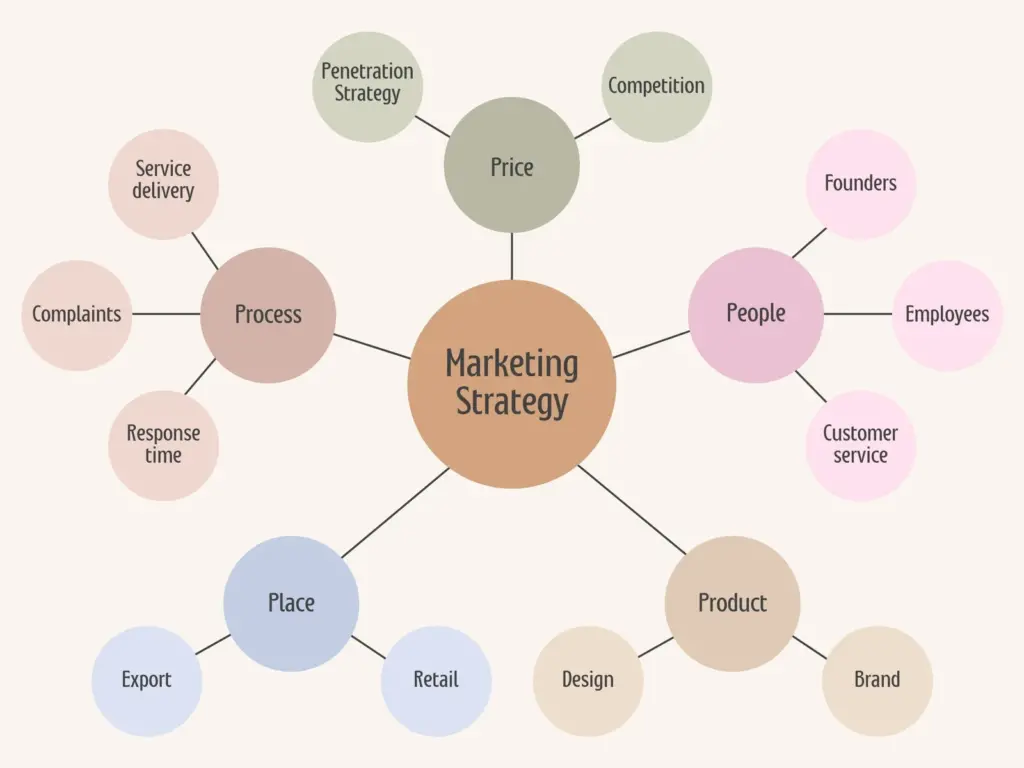
Concept Map

Concept maps are visual representations of relationships among various concepts. Ask students to produce a graphic representation of this relationship using pen and paper, whiteboards, post-its, or concept mapping software (e.g., Coggle)—video with details here.

https://www.canva.com/p/templates/EAE5oJfwZRk-concept-map-marketing-strategy-graph/
Individual/Group Activity Individually & Group
Class SizeSmall (<25), Medium (25-50), & Large (51-200)
Bloom’s Taxonomy LevelApply
Development InitialTransitional Knowing
Minimum Time to Facilitate16-30 Minutes
Minimum Time to Debrief< 10 Minutes
PDFsHere
Discipline-Specific Examples

STEM (Science, Technology, Engineering, and Mathematics)
Please contact us at activelearning@uga.edu with an example to include!

Humanities
Please contact us at activelearning@uga.edu with an example to include!

Social Sciences
Please contact us at activelearning@uga.edu with an example to include!

Co-Curricular
(experiences outside of the formal classroom but contribute to student learning)
Please contact us at activelearning@uga.edu with an example to include!

Universal Design for Active Learning

Universal Design for Active Learning
UDL and active learning share a common goal: centering all students in the learning experience. When designing an activity, UDL‑informed instructors consider how the activity could be open to all students while preserving the core learning goal.

Physical Considerations
If handwriting or drawing is not required, allow students to build their concept map using digital tools. Permit text-based outlines as an alternative.

Timing & Pacing
Allow extended time. Students may begin a draft in class and refine it afterward.

Social Interaction
Allow individual creation before sharing. Emphasize understanding over artistic quality.

Information Accessibility
Allow reference to notes and course materials — focus stays on relationships, not recall.

Ways to Participate/Express
Allow creation using paper, digital tools, or a text-based outline of relationships.

Online Adaptations

Coming Soon!

Additional Resources

Wang, Z., Adesope, O., Sundararajan, N., & Buckley, P. (2021). Effects of different concept map activities on chemistry learning. Educational Psychology, 41(2), 245-260: https://www.tandfonline.com/doi/full/10.1080/01443410.2020.1749567?casa_token=OH80xmQQxcMAAAAA%3AzWmhTUZgniOi6xQDL0lWcEHM7GZfgqqbNs1Rkk-L9UmxaaVzfFeLF_f5HcwBXcZYNiwnblpjPPU

Rosciano, A. (2015). The effectiveness of mind mapping as an active learning strategy among associate degree nursing students. Teaching and Learning in Nursing, 10(2), 93-99: https://www.sciencedirect.com/science/article/pii/S1557308715000050?casa_token=d4q_dRf718oAAAAA:Lj8UINh7I5i6Nxb1vX2NhetdeJTxQV3SgFJRZrPTh_VImdf43ghuFev9dLW0y_fo1GYdxcTg

Bauman, A. (2018). Concept maps: Active learning assessment tool in a strategic management capstone class. College Teaching, 66(4), 213-221: https://www.tandfonline.com/doi/full/10.1080/87567555.2018.1501656?casa_token=KNRhkRAPsZcAAAAA%3AoRRy70rIDQqmNgmOP3b87Xk3ltZ290m2WYwIvSCKjSfDIaM2xqBkC-U407UDilqb4k6PgRiCLKQ